O say can you sing?
No, I cannot sing our national anthem, nor anybody else’s national anthem

O say can you see, by the broadcaster’s light, what so proudly they sang, at the World Cup soccer tourney? Athletes from around the world are gathered in America, singing a whole host of national anthems before matches.
“O Canada” is one of the few international anthems I’m familiar with. Same for Britain’s “God Save the King / Queen” — whose tune we Yanks adapted for “Our Country, ’Tis of Thee.”
The very first national anthem was “La Marseillaise,” adopted by the French First Republic in 1795.
The U.S. didn’t have an anthem until 1931, when President Herbert Hoover signed “The Star-Spangled Banner” into law as the official national anthem.
The words of our anthem are from the poem “Defence of Fort M’Henry,” written by Francis Scott Key in 1814, during the War of 1812. The British Royal Navy was attempting to take Baltimore, but had to get past Fort McHenry at the harbor. British ships fired on the fort for 25 hours, with rockets’ red glare and bombs bursting in air. (Fun fact: The Royal Navy bomb ships included the HMS Terror, HMS Volcano and HMS Devastation.)
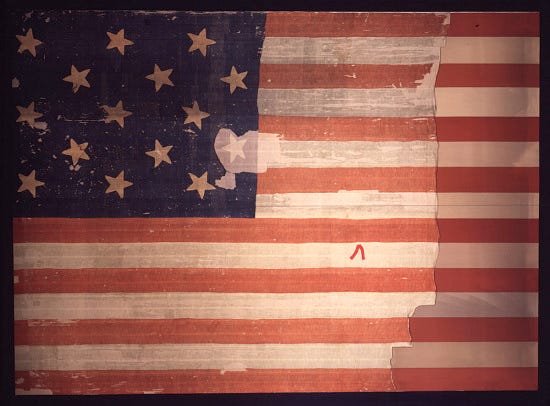
Fort McHenry survived the bombardment, and in the morning signaled victory by raising a garrison flag — the largest battle flag ever flown at the time, nicknamed “The Star-Spangled Banner.”
Francis Scott Key wrote the words to our national anthem, but he is not responsible for the music. The blame for that atrocious tune goes to a British gentlemen’s club called The Anacreonitic Society, named after an ancient Greek poet and dedicated to music and drinking (not necessarily in that order). The club song, “The Anacreonitic Song,” was quite popular at the time, for some inexplicable reason. Try singing its lyrics to the tune we all know and hate:
To Anacreon in Heav’n, where he sat in full Glee,
A few Sons of Harmony sent a Petition,
That he their Inspirer and Patron would be;
When this answer arriv’d from the Jolly Old Grecian
“Voice, Fiddle, and Flute,
“no longer be mute,
“I’ll lend you my Name and inspire you to boot,
“And, besides I’ll instruct you, like me, to intwine
“The Myrtle of Venus with Bacchus’s Vine.
Respect for rhyming “petition” with “Grecian.”
At least our anthem has a catchy title. Compare it to Tajikistan’s national anthem, whose name translates to … “National Anthem.” Thailand’s is “National Song.”
But there are many eloquently named national anthems.
• “One Single Night” (Burkina Faso).
• “Made of Hundreds of Flowers” (Nepal).
• “Lightning Over the Tatras” (Slovakia).
• “The Dawn of a New Day” (Benin).
• “Until the End of the World” (Myanmar).
• “Ukraine’s Glory Has Not Perished” (Ukraine).
• “Let Us Tread the Path of Our Immense Happiness” (Equatorial Guinea).
• “Forged from the Love of Liberty” (Trinidad and Tobago).
• “The Thunder Dragon Kingdom” (Bhutan).
Vanuatu has the most versatile national anthem. It’s called “Yumi, Yumi, Yumi,” which translates to “We, We, We.”
It can invoke something good to eat, or a simple but powerful expression of solidarity — or the sound the last little piggy makes.